Wheelie Bike Challenge 3D
- 4.6
- Rating
- 100.00K
- Installs
- Free
- Price

 Analysis by App-foxy
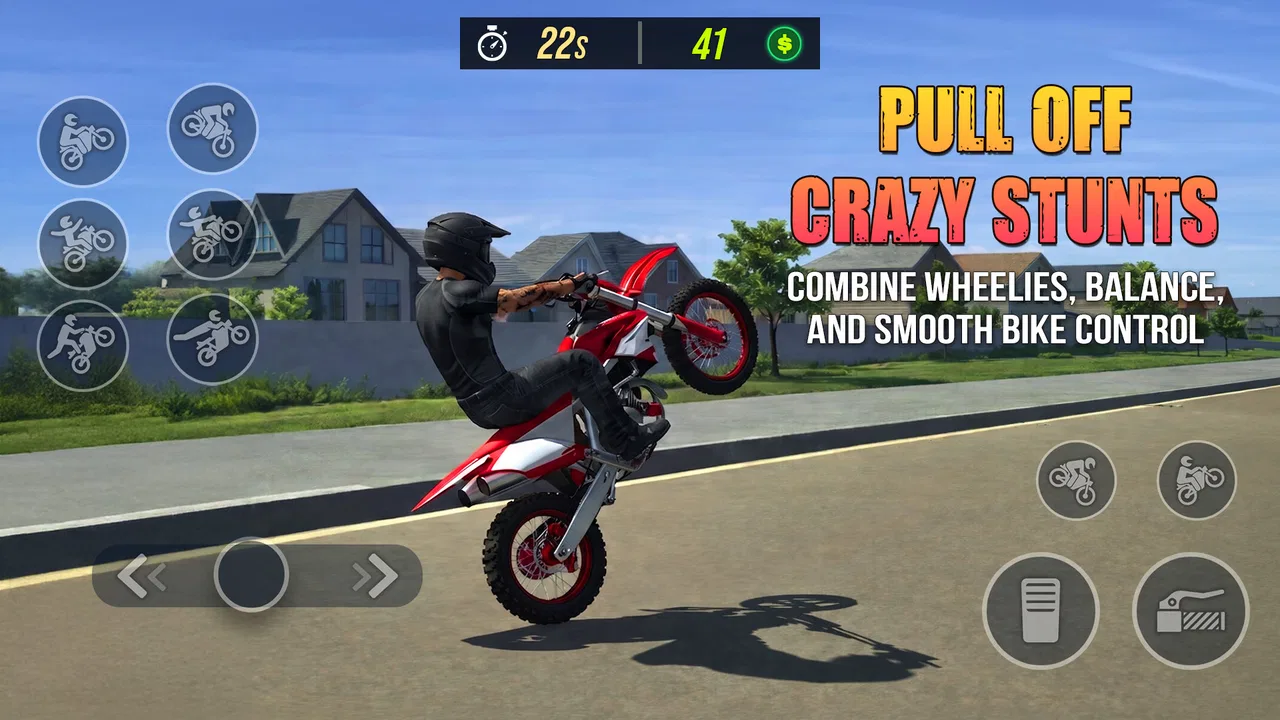
Wheelie Bike Challenge 3D is the kind of racing game I open when I want a quick test of concentration rather than a long, cinematic driving session. Its entire appeal comes from a simple idea: keep a motorcycle balanced on one wheel for as long as possible. That sounds approachable in the first few seconds, but the small margin between a controlled wheelie and an immediate crash gives every attempt a tense little finish.
I reviewed it as a lightweight mobile game from Wayfu Game Studio, and my first impression was clear: this is built around repetition, timing, and the satisfaction of improving a movement that initially feels awkward. It is free to play, aimed at Everyone, and available for devices running Android 7.0 or later. The current release is version 1.05, while optional in-app purchases cost $3.99 per item.
How the first attempts establish the goal
The opening goal is easy to understand without a long explanation. I need to raise the front wheel, keep the bike from tipping too far backward, and maintain control instead of treating the throttle like an on-off switch. That clarity is one of the game’s strongest qualities. I do not have to learn a large set of controls or study a complicated race map before I can begin making progress.
You May Also Like

 Pandora - Music & Podcasts
Pandora’s Music Is Easy to Start, but Harder to Recover
Pandora’s strength is its low-effort path from a seed to a station. Its weak spot is how much confidence it asks you to place in connection, setup, and quiet recovery.

 AccuWeather: Weather Radar
AccuWeather Review: A Quick, Clear Forecast for Everyday Decisions
For everyday plans, the best forecast is the one you can understand quickly. AccuWeather makes rain timing, radar, and local conditions easy to act on, with a few trade-offs.

 Hill Climb Racing
Why Hill Climb Racing Still Turns Crashes Into One More Run
A tiny car, a bumpy hill and one more upgrade: Hill Climb Racing keeps resurfacing because its simple chaos makes every near-miss feel personal.

 AliExpress - Shopping App
AliExpress Makes Global Shopping Feel Personal, but Shoppers Bear the Risk
AliExpress turns a global marketplace into a pocket-sized discovery engine. Its reach is useful, its shopping loop compelling, and its trade-offs easy to miss.

 Lords Mobile: Kingdom Wars
Lords Mobile Is a Kingdom-Building Routine, Not a Quick Match
A case-by-case verdict on the building, battles, device demands, and social commitments that make Lords Mobile rewarding for some players and exhausting for others.

 PDF Scanner app - TapScanner
TapScanner Makes Paperwork Easier to Capture, Check, and Share
TapScanner makes scanning with a phone feel less like a rescue operation and more like a dependable step in getting work done. Its capture tools are useful, though not flawless.
More From Our News Desk
View All News


At the same time, the simplicity creates a demanding first lesson. A wheelie is not really about going fast; it is about managing momentum. Pressing too aggressively can make the bike rotate beyond recovery, while being too cautious can leave the attempt flat and unproductive. The game therefore makes its early objective feel more like a balancing exercise than a conventional race.
I found the best way to approach the first sessions was to stop chasing a spectacular run immediately. Instead, I treated each attempt as a short experiment. I watched how much input the bike needed to lift, noticed the point where it began to lean too far, and then tried to make smaller corrections. That mindset matters because the game’s basic challenge is learned through muscle memory rather than through a large tutorial system.
For a casual player, this creates a useful pick-up-and-play loop. A spare minute is enough for several attempts, and failure is quick enough that restarting does not feel like a major commitment. For someone expecting a full racing campaign with overtaking, varied circuits, and detailed vehicle management, the narrow focus may feel limited from the start.
The game works best when I accept that the objective is precision. It is not trying to compete directly with a traditional track racer. There is no need to compare it with a game built around licensed cars or long championship events, because the appeal here is the small physical problem presented by every run: how long can I keep the bike stable while still moving forward?
Progress becomes visible through control, not spectacle
One interesting part of the experience is that improvement can be noticeable even when the game does not make a big announcement about it. During my early attempts, I was mainly reacting to mistakes. After spending more time with the controls, I began anticipating the bike’s movement and correcting before the wobble became dangerous. That change in timing is the clearest progress signal for me.
This is also where the game’s design can be more rewarding than its short description suggests. A successful run is not only about reaching a larger result; it is about making the bike feel less unpredictable. When I can hold the front wheel at a stable angle and use brief corrections instead of frantic ones, the challenge becomes more satisfying. The reward is a cleaner technique.
Players looking for obvious progression markers should set their expectations carefully. The central motivation comes from the attempt itself and from beating personal performance, rather than from a richly explained adventure structure. I would not choose this game if my main reason for playing were collecting a large roster of vehicles, following a story, or unlocking a long sequence of elaborate events.
That does not make the experience empty. It simply shifts the meaning of progress. In this game, a better run can come from understanding the balance point, learning when to ease off, and resisting the urge to overcorrect. Those are small improvements, but they are concrete ones. I could feel the difference in how often I lost control for reasons I understood versus reasons that seemed random.
A practical tip is to judge an attempt by the quality of its recovery, not only by its best uninterrupted stretch. If the bike starts leaning backward and I manage to bring it under control, that teaches me more than a lucky early lift. This approach makes repeated failures less frustrating and turns each restart into a focused practice session.
The difficulty curve rewards patience but can feel abrupt
The difficulty comes from the narrow timing window. The basic action is immediately understandable, yet reliable execution takes practice. That combination is effective because I always know what I am trying to do, but knowing the goal does not guarantee that my hands will perform it correctly.
I noticed that the challenge rises mainly through consistency. One good wheelie is not enough; I need to reproduce the same balance while dealing with the bike’s continuing movement. A player who prefers forgiving controls may find the curve sharp, especially if they expect the first few sessions to feel smooth. The game asks for attention very early rather than gradually introducing a large collection of mechanics.
This makes the title better suited to players who enjoy retrying a compact challenge. I can imagine it working well during a commute break, while waiting for an appointment, or after finishing a longer game and wanting something that demands focus without requiring a major time investment. In those situations, a failed attempt is easy to leave behind, and a successful one feels like a small personal victory.
It is less suitable for someone who wants a relaxed racing game to play with minimal concentration. The bike’s balance is the whole point, so casual tapping without watching the movement closely is unlikely to produce satisfying results. If I am tired or distracted, the game exposes that immediately.
Another trade-off is that the focused design leaves less room for variety than a conventional racing alternative. A standard racing game may offer multiple tracks, opponents, vehicle setups, and event types. Wheelie Bike Challenge 3D offers a more concentrated skill test. I prefer it when I want one mechanic refined into a challenge; I would choose a broader racer when I want exploration, competition, or a sense of a season unfolding.
What keeps the challenge going after the novelty
The retention pressure comes from the familiar thought that the next attempt could be cleaner. Because the control idea is so compact, I can immediately identify what went wrong: too much lift, a late correction, or a failure to settle the bike after gaining momentum. That clarity encourages another try more effectively than a vague feeling that I simply lost.
However, this loop depends heavily on whether I enjoy self-improvement. Players who need frequent new content may run into the limits of the format. The game’s premise can remain compelling for a while because balance is difficult to master, but repetition alone will not satisfy everyone. I would not recommend it as a primary game for someone who loses interest when the core action stays consistent.
The free entry point helps make experimentation easy. I can install it, test the controls, and decide quickly whether the wheelie-focused format suits me without paying upfront. The presence of optional purchases priced at $3.99 per item is worth remembering for anyone who prefers a completely purchase-free experience, even though the basic appeal of the game is available without an initial charge.
Its broad age rating also makes the concept easy to share with younger players, but the simple presentation should not be confused with effortless play. The controls may be easy to explain, while the timing remains demanding. I would describe it to a family member as accessible to start, not automatically easy to master.
One useful everyday scenario is using it as a short reset between tasks. After a long reading session, I can play a few attempts, focus on one physical objective, and stop without needing to remember a storyline or manage a large inventory. The same quality can work against it during longer sessions: once I have made several attempts, I may want a clearer change of pace than the game’s central challenge provides.
The rating is a positive sign of player reception, with a 4.6 average from around 344 ratings. It has also passed 100K+ installs, which suggests that the focused idea has found an audience. I treat those figures as useful context rather than a guarantee, because the right question is still whether repeated balance-based play matches my taste.
Who should play it and who should look elsewhere
I would recommend this racing game to players who like short skill tests, quick restarts, and mechanics that become more rewarding through practice. It is especially appealing if I enjoy games where progress is measured by better timing rather than by unlocking a huge collection of content. The direct objective also makes it easy to hand to a friend and explain in one sentence.
I would be more cautious about recommending it to players who want realistic motorcycle simulation, online competition, deep customization, or a long-form career. The game’s identity is much narrower. It is not a replacement for a full racing package, and expecting it to behave like one would make its simplicity feel like a weakness rather than a deliberate choice.
It may also be a poor fit for anyone who dislikes failure loops. The bike can punish a small mistake, and the natural response is to retry rather than move on to a different activity. That structure is satisfying when I am in a practice mood, but irritating when I want immediate success or a gentle way to pass time.
For Android users with older compatible hardware, the minimum requirement of Android 7.0 keeps the entry point relatively broad. I still recommend checking how the game feels on the specific device, because balance-focused controls benefit from responsive input. Even a simple mechanic becomes less enjoyable if the device makes corrections feel delayed or imprecise.
My verdict on its pacing and progression
Wheelie Bike Challenge 3D succeeds because it does not hide its main idea. The early goal is obvious, the difficulty comes from a real timing problem, and the most meaningful progress is learning to control the bike with less panic. That gives the game a coherent rhythm: attempt, understand, adjust, and try again.
Its pacing is strongest in short sessions. I can make a few runs, notice a specific mistake, and return later without a complicated setup. The pacing is weaker for players who need constant novelty, because the same balancing challenge remains the center of attention. That is not a flaw I would ignore; it is the main trade-off behind the game’s focused design.
The progression verdict is therefore favorable but specific. I think the real progression is improved control rather than a large unlock journey. If that kind of mastery sounds appealing, the game offers a clean and inexpensive way to practice it. If I want varied tracks, deep upgrades, or a broader competitive structure, a conventional racing title will be the better choice.
After spending time with it, I see Wheelie Bike Challenge 3D as a compact test of balance that earns its place through immediacy. It is free to start, simple to understand, and surprisingly demanding once I try to make a run consistent. I would recommend it to a friend who enjoys focused arcade challenges, while warning them that its narrow format and repetition are central to the experience, not temporary obstacles on the way to a larger campaign.
FAQs for Wheelie Bike Challenge 3D
01What is the main objective of Wheelie Bike Challenge 3D?
Wheelie Bike Challenge 3D is a thrilling game where the main objective is to perform and maintain a wheelie for as long as possible. Players must balance their bikes while navigating through various obstacles and terrains. The challenge intensifies with higher levels, offering a more complex environment to test your skills.
02Is Wheelie Bike Challenge 3D suitable for all age groups?
Yes, Wheelie Bike Challenge 3D is designed to be family-friendly and suitable for players of all ages. However, younger players might require guidance to understand the controls and gameplay mechanics. The game features cartoony graphics and straightforward controls, making it accessible and enjoyable for everyone.
03What are the key features of Wheelie Bike Challenge 3D?
The game offers several exciting features, including realistic physics, a variety of bikes to choose from, and multiple challenging levels. Players can enjoy smooth controls and customizable bikes, enhancing the overall experience. The game also includes leaderboards and achievements to compete with friends and other players globally.
04Are there in-app purchases in Wheelie Bike Challenge 3D?
Yes, Wheelie Bike Challenge 3D includes in-app purchases. Players can buy additional bikes, skins, and power-ups to enhance their gameplay experience. While the game is free to download, these purchases can provide an extra edge or aesthetic customization, though they are not necessary to enjoy the game fully.
05How does the game handle difficulty progression?
Wheelie Bike Challenge 3D offers a gradual increase in difficulty as players advance through levels. Starting with simpler courses, the game introduces more complex obstacles and tighter tracks, requiring precise control and timing. This progression keeps the gameplay engaging and challenging, catering to both newcomers and experienced players.
Pros
- Engaging 3D graphics enhance gameplay immersion.
- Intuitive controls make it easy for beginners.
- Varied levels offer increasing challenges.
- Quick load times for a smooth experience.
- Regular updates keep content fresh.
Cons
- Ads can be intrusive during gameplay.
- Limited customization options for bikes.
- In-app purchases can be pricey.
- Occasional lag on older devices.
- No offline mode available.

Wheelie Bike Challenge 3D
Gallery